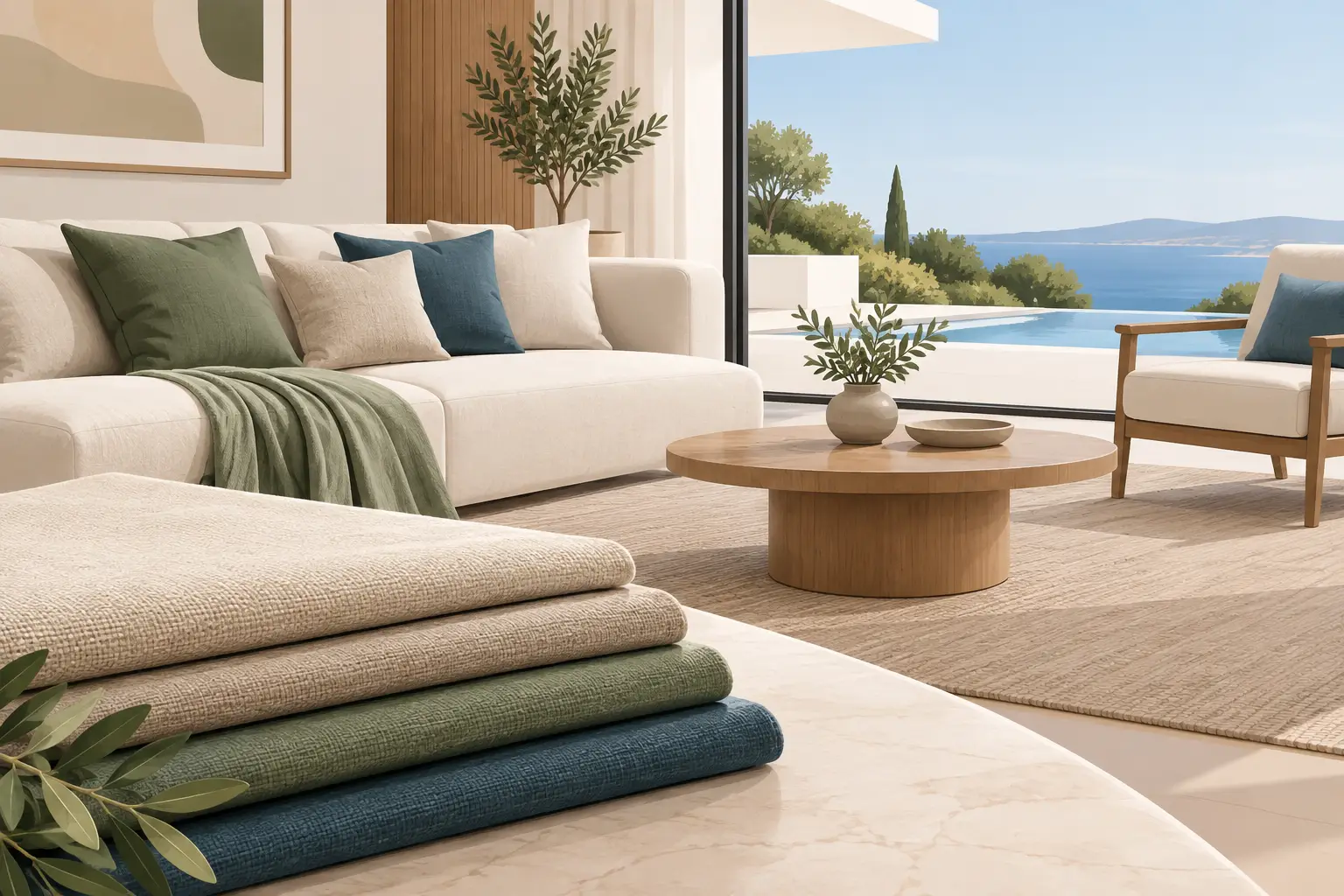
A villa is rarely experienced in one glance. It unfolds through shaded drawing rooms, sun-warmed terraces, generous bedrooms and the quiet transition spaces between them. Designer fabrics for villas give this architecture its atmosphere: they soften stone and timber, temper abundant light, improve comfort and allow each room to tell a distinct yet connected story.
The right textile scheme is not simply a matter of choosing a beautiful pattern. A villa asks more of its fabrics than a compact city residence. There may be soaring windows, exposure to intense sunlight, children and guests moving freely between indoors and out, and rooms that need to feel composed whether occupied by two people or twenty. The most successful schemes balance visual presence with performance, creating interiors that feel collected, liveable and built to endure.
Why designer fabrics for villas deserve a considered approach
Scale changes everything. A small sample of linen or velvet can look exquisite in the hand, but its character becomes far more pronounced when used across six metres of curtains, a pair of deeply upholstered sofas or a fully draped headboard. This is where a curated designer collection proves its value. The weave, repeat, weight and movement of a fabric have to be assessed in the proportions of the room, alongside the architecture and the quality of natural light.
In a villa, fabrics also create the necessary contrast to hard, often monumental finishes. Limestone floors, polished plaster, marble, dark joinery and expansive glazing have a certain authority, but without textile layers they can feel acoustically sharp or visually austere. Bouclé upholstery introduces softness without becoming precious. Washed linen offers an easy, light-catching texture. A finely woven wool adds depth and insulation, particularly in homes that are used across changing seasons.
There is an emotional dimension, too. A hand-blocked print in a guest suite can evoke a sense of place; a quietly tailored wool on a library chair brings calm and permanence. Fabrics shape the way a room receives its inhabitants. They can make a formal salon more inviting, a large bedroom more intimate, or a coastal villa feel polished rather than thematic.
Begin with the villa’s setting and rhythm
The most compelling interiors respond to their surroundings without becoming literal. A Mediterranean property may call for chalky linens, mineral hues, dry-textured wools and accents of ochre, olive or faded terracotta. In a wooded country setting, richer velvets, mohair, tobacco-toned leathers and botanical patterns can sit beautifully against the landscape. For a contemporary urban villa, a more architectural palette of ivory, ink, bronze and soft grey may allow sculptural furniture and statement lighting to lead.
Climate should influence the brief from the outset. In strong southern light, consider fabrics with good colourfastness, lined curtains and sheers that filter glare while preserving the view. Natural fibres remain exceptionally beautiful, but some require considered placement. A delicate silk may be perfect for a low-traffic formal room away from direct sun; it is less suitable for a south-facing family sofa or an unlined window treatment.
Privacy is equally important. Villas frequently have large openings designed to frame gardens, water or distant views. During the day, a translucent linen sheer can retain the architecture’s sense of openness. At night, a layered treatment of sheer, interlining and curtain fabric provides privacy, softness and a more complete visual finish. The treatment need not feel heavy. The beauty lies in choosing cloth with enough body to hang elegantly and in specifying the heading, track and return with the same care as the fabric itself.
Build a fabric language, rather than decorating room by room
A villa benefits from a clear thread running through it. This does not mean repeating one fabric everywhere. It means establishing a shared language of colour, tone, texture and craftsmanship, then varying the expression according to each room’s function.
Start with a restrained foundation: perhaps warm ivory, mushroom, tobacco, faded blue or soft stone. Introduce larger gestures in the principal rooms through an upholstery fabric, a patterned curtain or an expressive wallcovering. Secondary spaces can then carry a smaller-scale print, a contrasting trim or a richly textured plain that echoes the same palette. The result is progression, not repetition.
Let each room hold its own mood
In reception rooms, consider fabrics with a degree of presence. A tailored velvet, refined chenille or textural woven fabric gives seating the visual weight required in a generous space. Pattern can be effective here, particularly when it has a generous repeat that reads well from a distance. Collections from houses such as Dedar, Pierre Frey, Rubelli and Christopher Farr Cloth offer very different expressions of this idea, from understated texture to more artistic pattern.
Bedrooms invite a softer approach. Upholstered bed surrounds, full curtains, layered cushions and throws should create quiet rather than visual noise. A decorative fabric may be most effective on a single ottoman or as the facing on a pair of curtains, balanced by plain linen or wool elsewhere. The aim is a room that feels considered at midday and cocooning after dark.
For family rooms and media spaces, practicality becomes more prominent, but it need not compromise refinement. High-rub-count upholstery fabrics, stain-resistant finishes and tightly woven linens can withstand regular use. A performance fabric is not automatically the right choice for every surface, however. It can have a drier handle or a more technical appearance than natural fibre, so it is best selected where the lifestyle genuinely demands it.
Understand the qualities that cannot be seen in a photograph
Luxury is often felt before it is identified. The drape of a curtain, the resilience of a seat cushion and the way a fabric changes in evening light are all qualities that an image cannot fully convey. Sampling is therefore essential, especially for large installations.
Assess a fabric at different times of day and against the actual finishes in the villa. A pale grey may turn blue beside travertine, while a cream can appear unexpectedly yellow against crisp white plaster. Hold samples vertically for curtains, rather than only laying them flat, and view upholstery options against the timber, metal and stone they will accompany.
Pay attention to construction. For curtains, weight and weave affect how the cloth breaks and stacks when open. For upholstery, look at abrasion resistance, fibre content, backing and the suitability of the fabric for the intended frame. For cushions and decorative pieces, a more delicate silk, embroidery or handwoven textile may be entirely appropriate, provided it is placed with intention.
Trimmings are particularly effective in a villa because they bring definition at architectural scale. A narrow braid on a curtain leading edge, a contrasting piping on a sofa, or a fringe on a tailored ottoman can introduce bespoke character without relying on overt pattern. The distinction lies in restraint: a beautifully chosen detail reads as craftsmanship, while too many competing flourishes can dilute the room’s clarity.
Invest where touch, light and longevity matter most
Not every textile needs the same level of investment. Allocate the budget to pieces that are frequently touched, viewed at scale or difficult to replace: principal upholstery, full-height window treatments, headboards and bespoke seating. These are the elements that influence the villa’s daily experience and determine whether a scheme retains its poise over time.
More decorative fabrics can be introduced through cushions, lampshades, occasional chairs and upholstered screens. This approach permits seasonal adjustment without unsettling the foundation of the interior. It also creates room for a more expressive choice – a colourful ikat, a graphic stripe or a hand-embroidered cloth can become a memorable note within an otherwise serene composition.
Lead times deserve early consideration. Many premium fabrics are woven to order, and bespoke curtains or upholstery require skilled making, lining, fitting and installation. Planning textiles alongside joinery, lighting and furniture avoids rushed substitutions and ensures curtain tracks, recesses and furniture proportions are resolved before the finishing stage.
A final note on lasting character
The finest villa interiors do not announce every decision at once. They reveal their quality slowly: in the linen that moves gently at an open window, the depth of a woven sofa fabric, the precise edge of a trimmed cushion and the comfort of a room that has been designed for real life. Choose fabrics that honour the architecture, answer the way the home is used and still feel beautiful after years of sunlight, gatherings and everyday rituals.

21st September, 2026

19th September, 2026