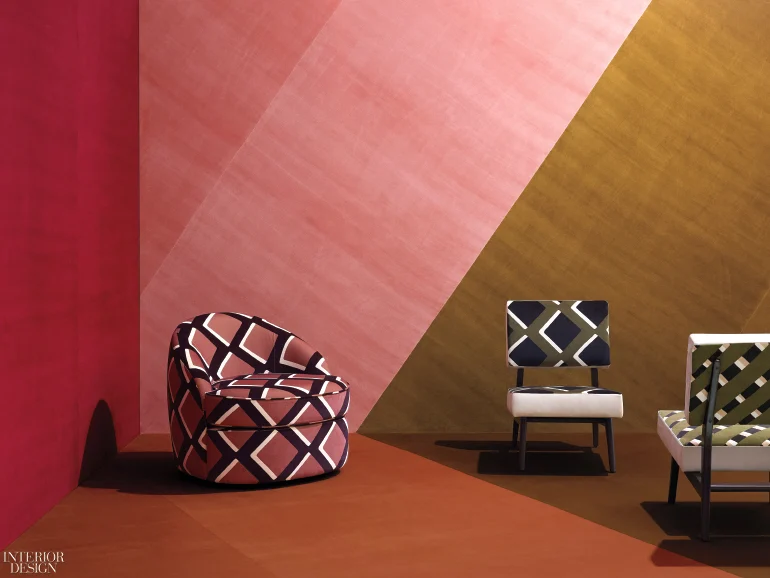
A Pierre Frey interior rarely feels merely decorated. It feels composed: alive with colour, informed by art and travel, yet resolved with the confidence of a room designed to be lived in for decades. For homeowners and designers who want personality without sacrificing refinement, the house offers an unusually rich vocabulary.
Pierre Frey is often recognised for its exuberant prints, but that is only part of its appeal. The French maison brings together archival intelligence, painterly imagination and technical craftsmanship across fabrics, wallcoverings, rugs and trimmings. Its collections can create a theatrical drawing room, a quietly elegant bedroom or a contemporary city residence with equal conviction. The difference lies not in the fabric alone, but in how it is edited, placed and balanced.
What Defines the Pierre Frey Aesthetic
Founded in Paris in 1935, Pierre Frey has developed a distinct point of view that resists the narrow categories of traditional and modern. The house is deeply connected to decorative history, yet its designs do not treat heritage as something fixed behind glass. Historic documents, global craft traditions, artists’ work and the natural world are reinterpreted with freshness, scale and chromatic assurance.
A toile may be enlarged until it becomes boldly graphic. A botanical motif may feel more like an artist’s study than a conventional floral. A woven stripe can introduce rhythm without appearing formal. This ability to move between periods and influences makes Pierre Frey especially compelling for clients creating layered homes rather than one-note schemes.
Colour is central to that character. Pierre Frey understands that colour need not shout to have presence. Earthy ochres, mineral blues, sun-warmed reds, chalky neutrals and unexpected accents are often nuanced enough to sit beautifully beside antique timber, contemporary plasterwork, bronze, stone and lacquer. The result is expressive, but never arbitrary.
A House Built on Narrative and Craft
The most memorable interiors tell a story through their materials. Pierre Frey offers the means to create that story in a way that feels personal rather than prescribed. Its decorative designs carry references to gardens, distant landscapes, art movements and historical textiles, while its plains, checks, textures and small-scale patterns provide the quieter passages a room needs.
That breadth matters. A large-scale printed linen may establish the emotional centre of a sitting room, but it needs thoughtful companions: a restrained upholstered velvet, a finely woven curtain fabric, perhaps a contrast piping or decorative braid. The beauty of working within the Pierre Frey universe is that pattern and restraint can be selected with a shared sensibility, rather than assembled from unrelated sources.
Craft is equally important. The handle of a cloth, the density of a weave, the clarity of a printed line and the way a colour sits within a ground all affect how a scheme is experienced at close range. These are details that photographs can suggest but not fully communicate. In a private home, they shape the quiet daily pleasure of drawing a curtain, sitting in a favourite chair or entering a room at different times of day.
Using Pierre Frey Fabric with Confidence
The strongest Pierre Frey rooms do not necessarily use the most pattern. They use pattern with intention. For a client drawn to a statement fabric, the question is not whether it is bold, but where it will have the greatest impact.
Let one element lead the room
In a reception room, a richly detailed textile may be most effective on curtains, where it has scale and movement. In a bedroom, it may belong behind the bed as a tailored upholstered headboard, softened by linen bedding and a more subdued wall treatment. In a smaller space, such as a cloakroom or entrance hall, an animated wallcovering can deliver an immediate sense of occasion without overwhelming the home as a whole.
Once the leading element is chosen, supporting materials should create contrast in texture, scale or sheen. A printed cotton can be given gravitas by a dry linen, a nubby bouclé, aged oak or a hand-finished plaster wall. Conversely, a formal architectural room may benefit from the softness and wit of a more lyrical Pierre Frey design.
Respect scale, light and distance
A fabric sample is not a room. This is particularly true of generous repeats and complex wallcoverings. A motif that appears dramatic on a hanger may become beautifully measured once seen across full-length curtains or a broad expanse of wall. Equally, a small, intricate design can lose definition in a large, low-light room.
Consider where the material will be viewed from, how daylight enters the space and what sits beside it. North-facing rooms may welcome warmth and depth; a sun-filled room can carry cooler shades or more intricate detail. Existing architectural elements matter too. Ornate cornicing, panelled walls and decorative fireplaces call for a different balance than the clean planes of a new-build penthouse.
Use expressive textiles where they can endure
Not every exquisite cloth is intended for every use. A delicate linen may be ideal for curtains or occasional cushions, while family seating, hospitality settings and high-traffic rooms often need more resilient upholstery qualities. This is not a limitation; it is an opportunity to place each material where it performs beautifully.
A considered scheme might use a more durable woven fabric on the main sofa, reserve a signature print for armchairs, and introduce the same colour family through cushions, lampshades or a contrast trim. The room retains its identity while meeting the demands of everyday life.
Wallcoverings, Rugs and the Power of a Complete Scheme
Pierre Frey’s influence extends well beyond upholstery. Wallcoverings can transform the atmosphere of a room with a level of immersion that paint alone rarely achieves. A hand-drawn scenic design can make a dining room feel cinematic; a textured or geometric paper can lend depth to a contemporary study. In either case, careful installation and considered sightlines are essential. A fine wallcovering deserves precision at every join, corner and architectural interruption.
Rugs bring another layer of composition underfoot. In an open-plan setting, a rug can define a conversation area and give furniture a sense of belonging. In more traditional rooms, it can soften architecture and introduce colour without competing with curtains or upholstery. The key is to judge the rug as part of the entire visual field, rather than a final accessory selected in isolation.
Trimmings are often the smallest decision with the most transformative effect. A contrasting braid, bullion fringe or tailored piping can sharpen the profile of a chair, frame a blind or bring a custom cushion into dialogue with the wider scheme. Used sparingly, these details create the sense that a room has been designed rather than simply furnished.
When Pierre Frey Is the Right Choice
Pierre Frey is particularly well suited to clients who value originality but do not want interiors that feel fashionable for a single season. It has a natural place in country houses, period townhouses and residences with strong architectural character, but it can be equally persuasive in contemporary settings. A modern interior gains warmth and cultural depth from an artisanal textile; a historic room gains energy from an unexpected colourway or enlarged pattern.
There are, however, moments when restraint is the more luxurious decision. If a room already contains highly figured stone, ornate joinery, extensive art or a major view, a Pierre Frey textured plain or elegant small-scale weave may serve the scheme better than a dramatic print. Luxury is not about adding more. It is about knowing which element should be allowed to speak.
For projects that require this level of discernment, Tobias Oliver Interiors approaches Pierre Frey as part of a wider, globally curated material library. The aim is not to impose a recognisable look, but to select pieces that belong to the architecture, the client’s life and the lasting character of the home.
Before committing to any textile or wallcovering, view it in the room where it will live. Let it meet the changing light, the existing finishes and the objects you intend to keep. The right Pierre Frey design will not simply fill a surface; it will give the room a point of view.

21st September, 2026

19th September, 2026