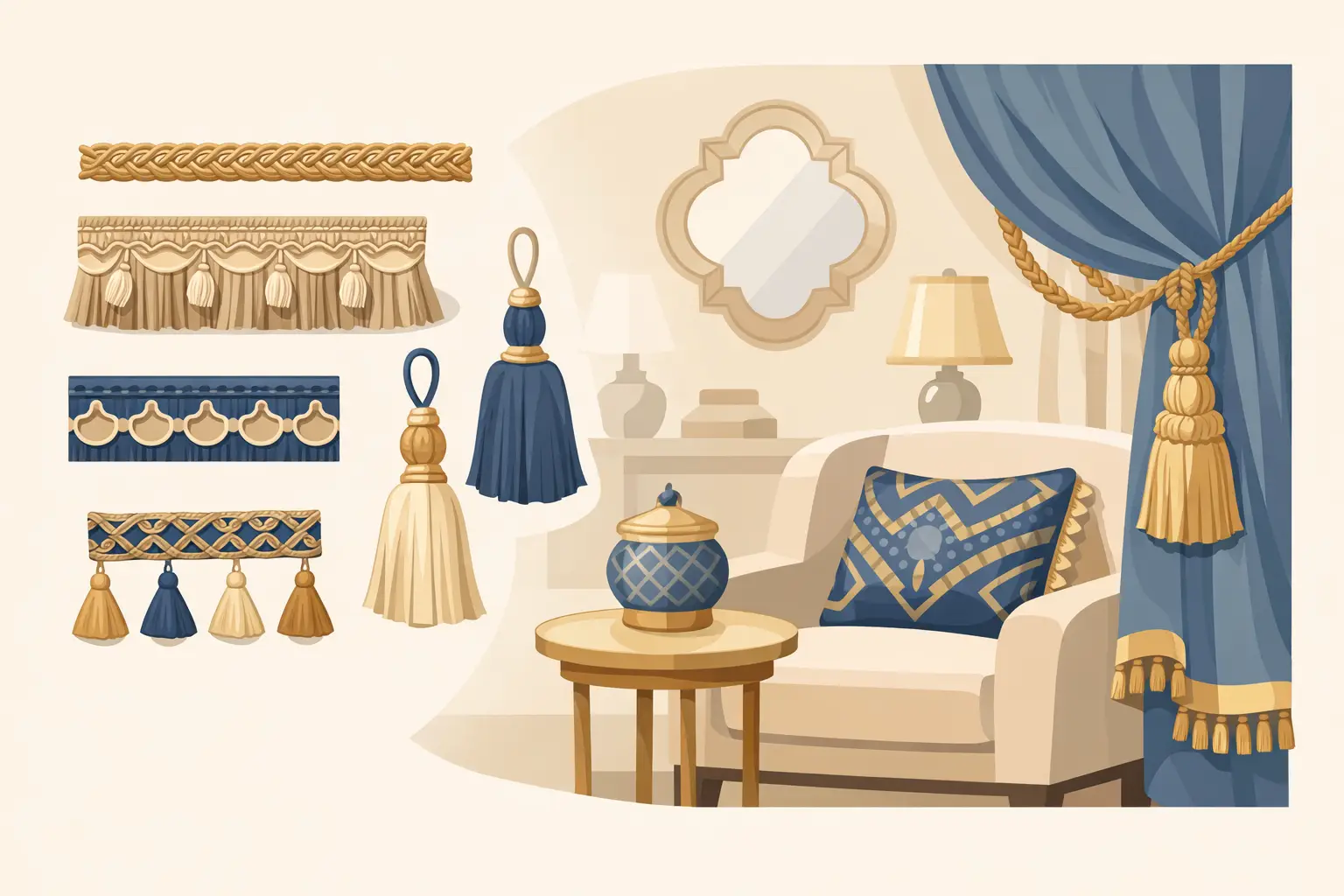
A curtain can be beautifully made and still feel unfinished. The same is true of a silk cushion, a tailored headboard or an upholstered chair. The answer to what is passementerie used for lies in this final, considered layer: it introduces definition, texture and a sense of completion, turning fine materials into interiors with greater presence.
Passementerie is the collective term for decorative trimmings made from thread, yarn, cord, braid and fringe. It has a long association with formal drapery and historic interiors, yet its place in contemporary design is far more versatile. Used with restraint, it can sharpen a modern scheme, bring depth to quiet neutral rooms or lend an otherwise simple piece of upholstery a distinctly bespoke character.
What is passementerie used for in luxury interiors?
Passementerie is used to outline, frame, soften and enrich. It can define the leading edge of curtains, conceal the join between two fabrics, create a tailored border on a cushion or bring movement to the base of a skirted chair. In more expressive settings, tassels, bullion fringe and elaborate braids become decorative features in their own right.
Its value is not merely ornamental. A well-chosen trim creates a visual transition between surfaces and materials. It may pick up the warm metal of a wall light, echo the dark timber of a cabinet or introduce a note of colour that connects a patterned wallcovering with plain upholstery. In this way, passementerie gives a room a more composed, intentional rhythm.
For an interior that values longevity over novelty, this is particularly useful. Rather than replacing a perfectly good sofa or reupholstering an entire room, a fresh contrast welt or elegant brush fringe can quietly transform the piece. It is a small gesture with disproportionate effect.
Defining curtains and window treatments
Curtains are perhaps the most familiar use of passementerie. Applied along the inner edges of a pair of drapes, a narrow braid can draw the eye vertically and give the window a more architectural presence. A contrast tape can also make a plain linen or wool feel more formal without overwhelming its natural texture.
Leading-edge trims are especially effective where curtains sit against patterned wallcoverings or richly coloured walls. They establish a clean boundary, preventing the fabrics from visually dissolving into the background. On generous interlined curtains, a deeper fringe or decorative braid can lend weight and ceremony, particularly in drawing rooms, dining rooms and principal bedrooms.
Tiebacks and tasselled holdbacks offer a more traditional interpretation. They are best reserved for rooms that have the scale to carry them, such as a country house sitting room or a high-ceilinged city residence. In a pared-back contemporary space, a simple corded tieback may feel more appropriate than a large, ornate tassel. The principle is proportion, not nostalgia.
Elevating upholstery without changing its silhouette
On upholstery, passementerie often performs its most refined work. A contrast cord, sometimes called piping or welt, follows the seams of a sofa, armchair or ottoman. It brings clarity to the shape, especially on furniture with sculptural lines, and creates a subtle dialogue between the main cloth and a secondary accent fabric.
A tonal cord can be almost imperceptible, adding shadow and definition rather than contrast. This suits bouclé, velvet, linen and wool where the aim is quiet sophistication. A bolder cord in leather, silk or a contrasting woven yarn can make a stronger statement, but it needs to relate to the room’s wider palette. A trim chosen in isolation can look decorative; one that reprises a colour from the rug, artwork or curtains feels integral.
Braids are also used to conceal the raw edge of fabric where a seam is not desired. They are particularly effective on headboards, upholstered screens and occasional chairs. A tailored tape can lend a contemporary graphic quality, while a hand-finished gimp braid offers a softer, more artisanal result.
Fringe deserves more careful consideration. Applied to the lower edge of an ottoman, chaise or upholstered stool, it creates movement and makes the furniture feel grounded. It is not limited to period schemes. A fine, tonal skirt fringe beneath a clean-lined sofa can introduce sensuality and softness into a modern room without altering its essential silhouette.
Adding distinction to cushions and soft furnishings
Cushions provide an ideal scale at which to experiment with passementerie. A narrow contrast flange, a brush fringe around the perimeter or a braided inset can turn a simple cushion into a considered decorative object. Because cushions are relatively easy to update, they also offer a lower-commitment way to introduce colour, texture or a more decorative note into a room.
The most successful combinations tend to balance pattern and restraint. A richly patterned fabric may only need a fine cord in one of its quieter colours. Conversely, a plain silk, velvet or linen can support a more textural fringe. Large tassels can be handsome on generously proportioned cushions in a library or bedroom, but may feel overly theatrical on smaller scatter cushions.
Passementerie can also finish throws, bed valances and table skirts. In bedrooms, a carefully selected braid around a bed base can connect the scheme to the window treatment and upholstered headboard, giving the room a layered, privately tailored quality.
Framing walls, screens and decorative details
Although fabric furnishings are its natural home, passementerie can be used more imaginatively. Fabric-panelled walls may be bordered with braid to create a handsome, architectural grid. This is particularly effective in dressing rooms, studies and bedrooms, where it adds depth while preserving the acoustic and tactile benefits of textile walling.
Decorative cords can outline upholstered wall panels or define the edges of a fabric-lined niche. Applied sparingly, this approach creates a finish that feels closer to cabinetry or joinery than conventional decoration. It can make a room feel designed at every level, from the grand gesture to the smallest junction.
Lampshades are another considered opportunity. A fine fringe around the lower edge of a shade softens the pool of light and gives an ambient, intimate quality, particularly in bedrooms and evening spaces. Here, a trim should complement the scale of the lamp and the lamp’s silhouette. Heavy fringe on a small shade can look disproportionate, while an overly delicate braid can disappear on a substantial base.
Choosing the right style of passementerie
The right trim depends on the fabric, the room’s architecture and the desired degree of formality. Linen and wool usually benefit from matt braids, woven tapes and softly textured cords. Velvet can carry richer fringe, silk braid or lustrous tassels because its surface already has depth. Bouclé often needs a simpler finish, so that its tactile character remains the focus.
Colour is equally influential. Tonal passementerie creates refinement through texture and shadow, while contrast makes the trim part of the room’s visual language. A dark cord on pale upholstery can lend graphic precision. A soft, near-matching braid will appear more understated but no less luxurious.
Scale should never be an afterthought. A broad braid or substantial bullion fringe may be magnificent in a room with tall ceilings and deeply upholstered furniture, yet feel oppressive in a compact sitting room. Smaller rooms often benefit from narrow tapes, fine cords and carefully placed accents rather than trims applied everywhere.
Craft, performance and practical considerations
High-quality passementerie is a specialist finishing material, and its construction matters. Natural fibres, silk blends and complex woven braids have exceptional beauty, but some will be less suited to hard-working family rooms, direct sunlight or frequent cleaning. Decorative tassels and loose fringe can also be impractical on furniture used daily by young children or pets.
For frequently used upholstery, a firmly woven cord or durable braid is generally the wiser choice. Position is important too. Trim placed along an exposed seat edge may receive more wear than trim used on the back or lower skirt of a chair. A skilled upholsterer or curtain maker will advise on placement, joins and how the trimming will behave over time.
Installation is not a detail to leave to chance. Corners, mitres, pattern matching and the tension of the braid all influence the final result. Bespoke work is often where passementerie proves its worth most clearly: it allows the scale, colour and placement to be resolved precisely for the piece rather than treated as an afterthought.
Using passementerie with a contemporary eye
The enduring appeal of passementerie lies in its ability to bring human touch to an interior. It speaks of workmanship, of materials selected with care, and of rooms assembled rather than simply furnished. Yet it does not require a maximalist approach.
One beautifully fringed ottoman, a pair of curtains edged in a textural braid, or cushions finished with a fine cord can be enough to shift the atmosphere of a room. The most persuasive schemes use trimming to reveal the quality already present in the fabric and form. Chosen with discernment, passementerie does not merely decorate a space – it gives the space a more personal and lasting point of view.

1st September, 2026

30th August, 2026