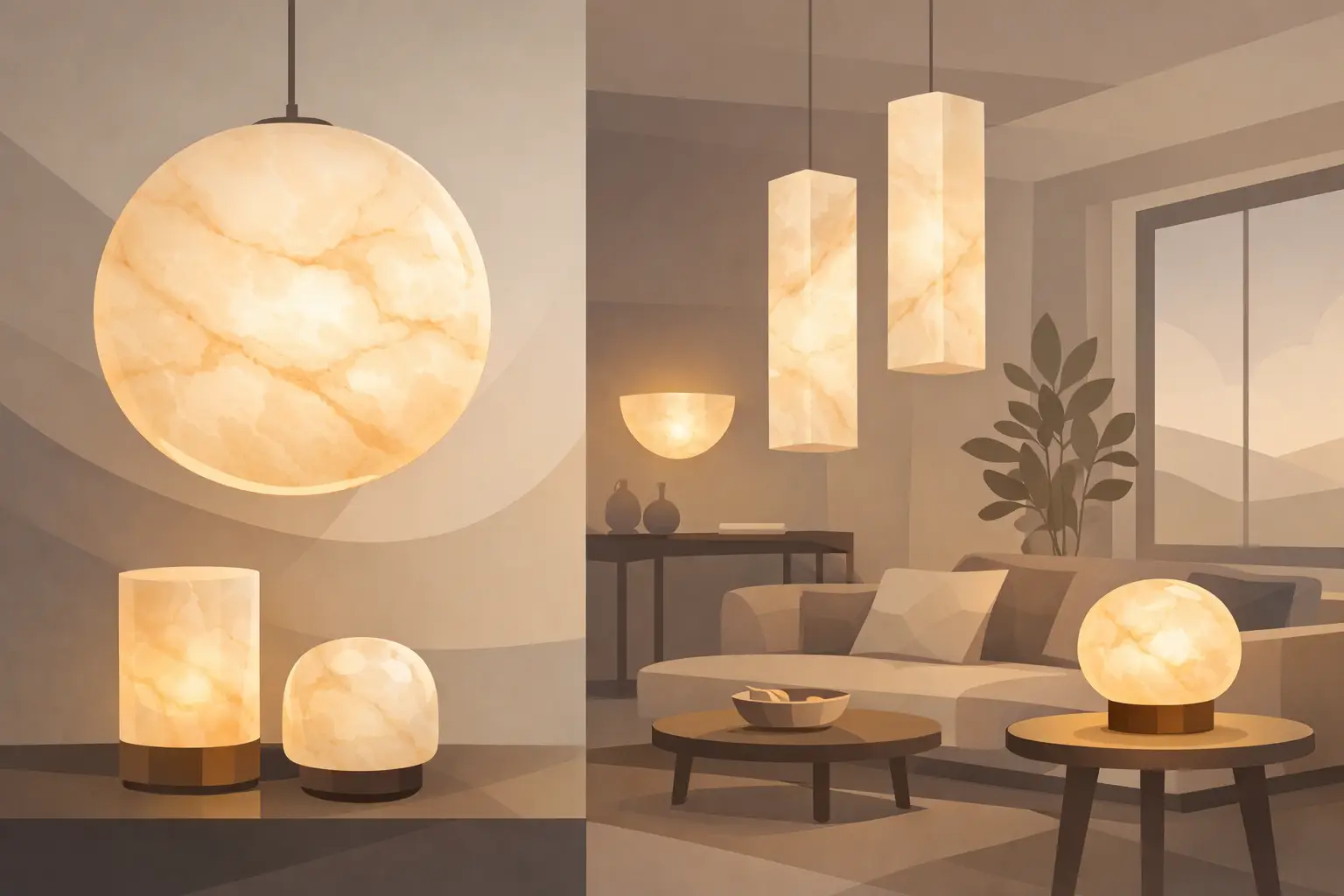
Alabaster does something few materials can: it turns illumination into atmosphere. Knowing how to choose alabaster lighting is therefore less about selecting a fitting in isolation and more about considering how its softly veined surface will change a room after dusk – adding warmth, depth and a quiet sense of occasion.
For rooms shaped around natural materials, considered furniture and artful restraint, alabaster offers an enduring counterpoint to more functional lighting. Its appeal lies in variation. No two pieces will transmit light in quite the same way, and that individuality is precisely what gives a well-chosen fitting its presence.
Begin with the quality of light
Alabaster is prized for translucency rather than brightness. When lit from within, it diffuses the source into a gentle, even glow, often with tonal movement created by the stone’s natural veining. The effect is flattering, intimate and architectural, but it is rarely intended to be the sole practical light source in a room.
This distinction should guide the specification. In a drawing room, an alabaster table lamp or floor lamp can soften the edges of an evening scheme, while concealed joinery lighting, picture lights and discreet directional fittings perform more exacting tasks. In a hallway, a pendant or flush mount can establish a graceful arrival, provided it is supported by enough ambient illumination to make the space feel effortless rather than theatrical.
Consider the mood you want the room to hold. Warm-white lamps, generally around 2700K, allow alabaster’s cream, honey and ivory tones to read naturally. Cooler light can make the stone appear flatter or greyer, particularly in rooms with silvered woods, pale plaster and blue-based textiles. Dimming is equally valuable: a dimmable alabaster fitting has the range to move from composed daytime ambience to a more enveloping evening glow.
How to choose alabaster lighting by room
The right form depends on what the light must do, as well as what the room needs to say.
Entrance halls and corridors
An alabaster ceiling light introduces material richness without demanding visual clutter. In a lower hallway, a flush mount or semi-flush design keeps circulation clear while making the ceiling feel considered. Where there is a generous stairwell or double-height entrance, a suspended alabaster lantern or multi-drop composition can provide a sculptural focal point.
Scale is critical here. A fitting that is too slight will recede into an expansive hall; one that hangs too low can compromise sightlines and proportion. Measure not only the room but also the door swing, stair pitch and the view from adjoining spaces. Lighting should create a sense of progression through a home, not interrupt it.
Dining rooms
Above a dining table, alabaster brings a particularly civilised quality of light. Its diffusion is kind to faces and table settings, encouraging the unhurried feel that makes a dining room inviting long after the meal is served. Linear designs suit long rectangular tables, while a centred pendant, lantern or clustered arrangement can anchor a round or oval table.
The fitting should relate to the table rather than merely the ceiling. As a starting point, it often looks most resolved when it occupies roughly half to two-thirds of the table’s width, leaving enough visual breathing space around it. Height matters too: low enough to define the table, high enough to preserve conversation across it. A specialist installer can refine this according to ceiling height and the scale of the piece.
Bedrooms and dressing spaces
Bedside alabaster lamps, small pendants or wall lights lend a bedroom the composure of a well-appointed suite. Here, choose fittings with a shade or diffuser that conceals the lamp source and avoids glare when reclining. Pairing wall lights with flexible reading lights can be an elegant solution where the bedside surface is intentionally spare.
In a dressing room, alabaster should complement rather than replace accurate task lighting. Its warmth is beautiful around a central island or at a seating area, but mirrors still require carefully positioned, high-quality light for dressing and grooming.
Bathrooms and spas
The material’s softness is especially compelling against honed stone, polished plaster, brushed metal and timber. Yet bathrooms demand technical discipline. Confirm the fitting’s IP rating for its intended zone, particularly near a basin, shower or bath, and ensure the electrical specification meets local requirements. An alabaster wall light can feel deeply luxurious in a cloakroom, but it must be selected for the conditions rather than adapted to them.
Look closely at the stone and workmanship
Alabaster is a natural material, so perfect uniformity is neither realistic nor desirable. Some pieces are almost cloud-like and pale; others have pronounced caramel, russet or grey veining. Ask to see imagery of the actual fitting where possible, especially for a statement piece. A studio photograph shows the design, but it may not reveal the individuality of the stone selected for your order.
The best pieces balance material presence with precise construction. Examine the thickness of the alabaster, the consistency of its illumination, the quality of joins and the finish of the metalwork. Brass, bronze, nickel and dark patinated finishes each change the character of the stone. Aged brass can heighten its warmth and classical undertone, while bronze gives it graphic definition in a more contemporary interior.
Also consider the language of the form. A simple cylindrical pendant can feel calm and modern; carved or fluted alabaster introduces more shadow and historic reference. Neither is inherently superior. The choice depends on whether the surrounding architecture calls for crisp restraint, layered decoration or a deliberate conversation between the two.
Balance scale, proportion and visual weight
Alabaster has visual density even when its illumination feels light. A compact fitting can hold its own beside substantial joinery, a veined fireplace or richly textured wallcovering, whereas a large lantern may become the principal architectural gesture in a pared-back room.
Before committing, assess the fitting from the key viewpoints: seated on the sofa, entering through the door, ascending the stairs and looking through an enfilade of rooms. In a home with open-plan spaces, repeated alabaster elements can create a subtle thread between zones, but repetition needs variation. A ceiling pendant in one area and related wall lights elsewhere will feel more collected than identical fittings used indiscriminately.
Ceiling height changes the equation. Tall rooms can carry deeper shades, multiple tiers and larger volumes. In standard-height spaces, a shallow flush light, fine pendant or pair of wall sconces may offer the same material impact without compressing the room. The most luxurious result is seldom the largest piece; it is the piece that makes the architecture feel more resolved.
Plan the lighting scheme, not just the fitting
An alabaster fixture earns its place within a layered scheme. Think in terms of ambient light for general comfort, task light for reading, cooking or dressing, and accent light for art, texture and architectural detail. Alabaster is usually strongest in the ambient and decorative roles, where its distinctive diffusion can be appreciated.
Control should be considered early. Put decorative fittings on separate dimmable circuits where possible, rather than grouping every source onto one switch. This gives a room the flexibility to shift throughout the day: practical light for arrival and activity, lower pools of light for dinner, conversation or quiet retreat.
Do not overlook the bulb specification. An exposed or poorly placed lamp can disrupt the calm opacity of the stone. Select a high-quality dimmable LED with warm colour temperature and high colour rendering, then test it with the fitting if possible. The difference between a merely adequate lamp and a beautifully judged one is surprisingly visible through alabaster.
Care, placement and longevity
Alabaster is softer and more porous than marble, which is part of its tactile appeal but also a reason to treat it with care. It should be dusted with a soft, dry cloth and kept away from abrasive cleaners, acidic products and excessive moisture. Avoid placing a table lamp where it will routinely meet splashes, fragranced oils or a crowded drinks tray.
For valuable or large-scale installations, professional fitting is wise. The stone can be weighty, and a ceiling’s fixing point, wiring and load-bearing capacity should be assessed before a decorative decision becomes an installation problem. This is particularly relevant in period properties, where plasterwork and existing electrics may require sensitive attention.
Choose alabaster when you want light to feel collected, not simply installed. A thoughtfully proportioned piece will not shout for attention, yet each evening it will shape how a room is experienced – making familiar surroundings feel warmer, calmer and more distinctly your own.

28th August, 2026

26th August, 2026