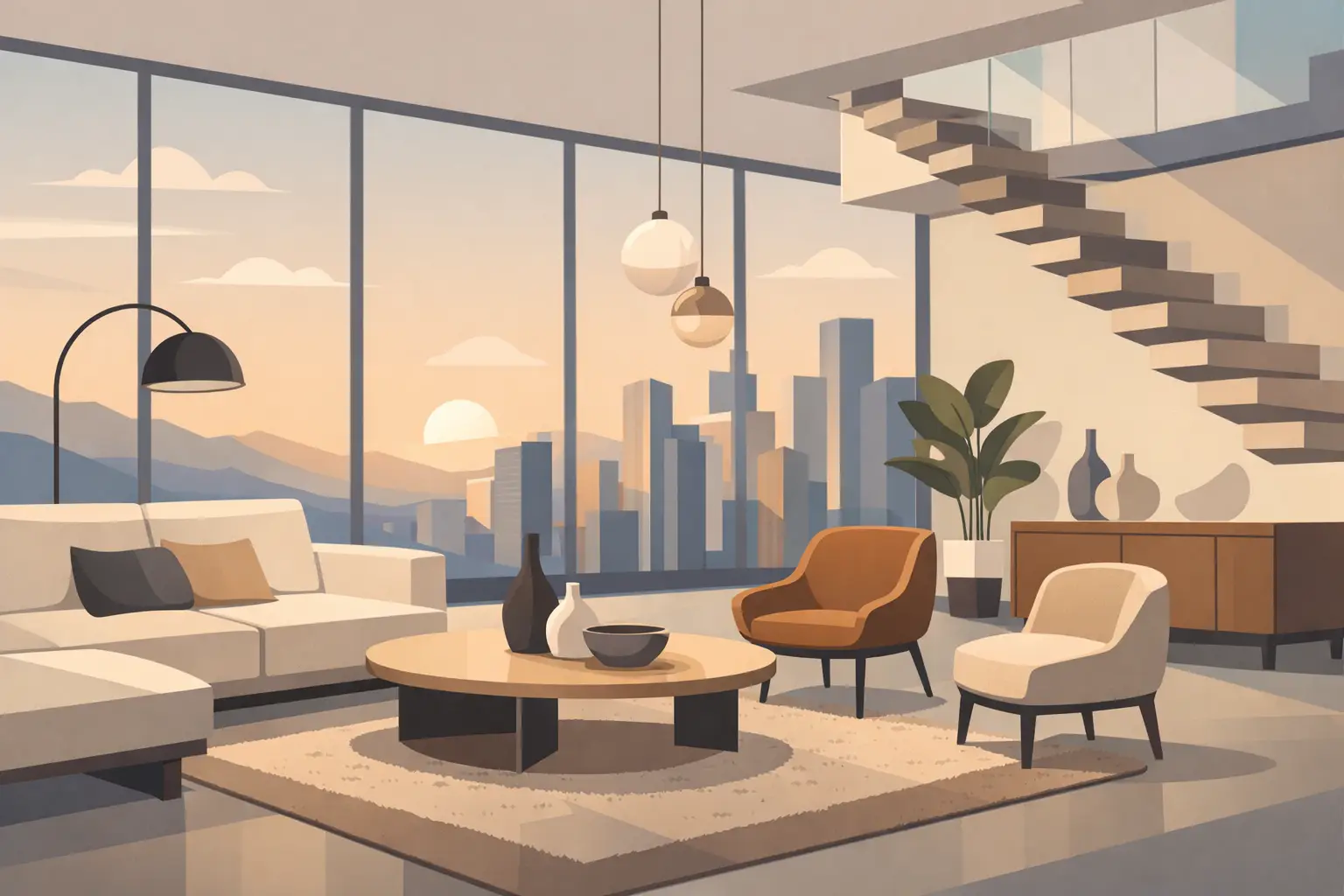
A penthouse is not simply a larger flat with a better view. Its scale, natural light and connection to the skyline ask more of every design decision. Knowing how to furnish a penthouse is therefore less about filling impressive rooms and more about creating a composed sequence of spaces that feels intimate, expressive and entirely at ease above the city.
The most successful penthouse interiors balance architectural clarity with personal warmth. They allow exceptional materials, confident silhouettes and carefully controlled light to shape experiences, while retaining the comfort needed for daily life, weekend entertaining and quiet evenings at home.
Begin with the architecture, not the shopping list
Before selecting a sofa or statement chandelier, understand what makes the residence singular. A double-height reception room, wraparound terrace, floor-to-ceiling glazing or original ceiling detail should guide the scheme rather than compete with it. The finest interiors do not treat architecture as a blank backdrop. They make it more legible.
Study the views at different times of day. A city panorama may be the central drama after dark, while a softer outlook towards water, trees or distant hills may set the mood in daylight. Position principal seating to enjoy the outlook without forcing every piece of furniture to face the windows. A room in which everyone sits in a line, looking outwards, can feel more like an observation deck than a home.
Equally, consider the movement through the property. Penthouses often have expansive open-plan areas, but openness still needs definition. Establish natural thresholds through rugs, changes in lighting, joinery, screens or a deliberate shift in furniture orientation. This creates rhythm, allowing each area to tell its own story while preserving a coherent whole.
Set a confident design language
A penthouse benefits from a clear point of view. This need not mean a strict style label. It may be an interplay of polished plaster, dark timber, aged bronze and pale bouclé, or a more colourful dialogue between lacquered furniture, graphic wallcoverings and hand-finished ceramics. What matters is consistency of tone.
Choose a restrained architectural palette first, then layer character through furniture, art, textiles and objects. Warm stone, limed oak, smoked glass and softly veined marble tend to hold their own in high-light interiors, while giving a sense of permanence. Where the building has a cooler, contemporary shell, richer timber, tobacco linen, textured wool and patinated metal prevent the result from becoming clinical.
Avoid interpreting luxury as visual excess. A room with several highly decorative gestures can lose the impact of each one. Instead, allow a few exceptional elements to carry presence: a sculptural centre table, a hand-finished cabinet, an arresting wallcovering, or a pair of lamps with beautifully weighted shades. The spaces between them are part of the composition.
Let one material recur
Repetition is a quiet way to create refinement. A bronze finish might appear on cabinet handles, occasional table legs and picture lights. A particular green drawn from a silk velvet could reappear in the dining chair piping and a hand-knotted rug. These connections make a large home feel intentional rather than assembled room by room.
How to furnish a penthouse room by room
The reception room usually carries the greatest responsibility. It must feel generous enough for guests, yet comfortable for two people on an ordinary Tuesday evening. Rather than relying on one oversized sectional, consider a tailored arrangement of two sofas facing one another, softened with swivel chairs that can turn towards the view or into conversation. This gives the room flexibility and makes the centre feel purposeful.
Anchor the seating with a generously proportioned rug. In a penthouse, undersized rugs are particularly disruptive because they expose too much floor and make furniture appear to drift. At minimum, the front legs of every major seat should sit on the rug; in more formal schemes, it is often preferable for the entire arrangement to rest upon it.
The dining space should be treated as a destination, not an afterthought beside the kitchen. A substantial table in figured timber, stone or lacquer can establish ceremony, especially when paired with chairs that are as inviting as they are elegant. Above it, decorative lighting should define the table’s proportions rather than merely illuminate it. For long tables, a linear composition of pendants or a series of sculptural fixtures can be more graceful than one central fitting.
In the principal bedroom, prioritise tactility. The bed should be generously upholstered or framed in considered timber, with a headboard tall enough to give the room stature without obscuring the architecture. Introduce layers through wool, cashmere, linen and silk, selecting fabrics that feel as considered in morning light as they do beneath evening lamps. A bedroom need not be minimal to be restful, but it does need visual calm.
Guest rooms may be smaller, though they deserve the same level of finish. A compact upholstered chair, bedside lamps with character, a beautiful throw and a small framed artwork can make visitors feel received rather than accommodated.
Use lighting to change the mood, not just the brightness
Lighting is often the dividing line between an expensive penthouse and one that feels genuinely resolved. Glass walls and high ceilings can make a home appear spectacular by day but stark at night if illumination is limited to downlights.
Build the lighting in layers. Architectural lighting provides practical coverage; decorative fixtures bring personality and scale; table and floor lamps create intimacy at eye level. Dimmable circuits are essential, particularly in entertaining spaces, where the mood should move easily from bright afternoon to candlelit dinner.
Consider the reflections created by glazing, mirrors and glossy finishes. A striking pendant might appear twice in the glass after dark, which can be beautiful or distracting depending on its placement. Lamps with fabric or parchment shades offer a flattering pool of light and soften hard surfaces, while wall lights can give corridors, dressing rooms and quieter corners a sense of considered hospitality.
Give large rooms human scale
One of the central challenges of furnishing a penthouse is resisting the urge to make every piece enormous. Large rooms require presence, but scale is achieved through proportion and grouping, not simply bulk. A vast sofa can be impressive in isolation yet uncomfortable in use; a carefully arranged pair of sofas and several occasional chairs often creates more gracious volume.
Use furniture with varied heights. A low lounge chair, a mid-height sofa, a tall cabinet or screen, and a substantial lamp create a more engaging silhouette across the room. This is particularly valuable in double-height spaces, where low furniture can otherwise feel stranded beneath a large ceiling plane.
Art also has an important role in grounding scale. One substantial work may be more effective than a scattered collection of small pieces. Where a wall is particularly broad, consider a curated series with shared framing or a textile artwork whose texture changes with the light. Art should have room to breathe, especially when competing with an exceptional view.
Make the terrace part of the interior story
A terrace is an additional room, not a furnishing afterthought. It should relate to the interior through colour, materials or form, while accepting the practical demands of sun, wind and changing weather. Outdoor upholstery, powder-coated metal, teak and stone are enduring choices, but their comfort matters just as much as their resilience.
Create distinct moments outside: a dining setting for long lunches, a lower lounge arrangement for evening drinks, and perhaps a solitary chair placed for the best morning view. Planters can introduce softness and privacy, but avoid blocking the very outlook that gives the penthouse its distinction. Low, sculptural planting often frames a view more elegantly than a dense perimeter.
Edit until the rooms feel effortless
A penthouse can accommodate many beautiful things, which is exactly why restraint matters. Decorative accessories should punctuate the interior rather than cover every surface. A hand-blown vase, a sculptural bowl, a stack of art books and a finely framed photograph may be all a console requires.
The same discipline applies to cushions, trims and pattern. These are opportunities to introduce depth and individuality, particularly in neutral schemes, but each should earn its place. Mix textures such as velvet, linen, bouclé and braid with confidence, then allow a quieter fabric or plain wall to give the eye a place to rest.
A truly successful penthouse does not announce its value through excess. It reveals it in the weight of a drawer pull, the fall of a curtain, the glow of a well-chosen lamp and the ease with which people settle into the room. Begin with the life you want the home to hold, then let every considered piece make that life feel more beautiful.

3rd September, 2026

1st September, 2026